Barndominium Kits vs Modular & Prefab Homes in Colorado
People searching for a modular barndominium or a prefab barndominium in Colorado are usually choosing between three things that look alike in photos: a barndominium kit, which is a steel or pole-barn shell delivered to your land and built there; a modular home, built in a factory to state-approved plans; and a manufactured home, built to HUD's federal code. Colorado treats them very differently. This guide sets out how each is approved and inspected, what goes under it, how the snow its roof must carry is decided, and how lenders and appraisers see it. To be plain about our side: we build site-built barndominiums from kits and as turnkey projects. We do not sell, broker or install modular, manufactured or tiny homes, which in Colorado is the business of sellers and installers who hold Division of Housing registration.
Figures on this page are cited third-party or government data, not a quote from Colorado Barndominium Builders.
Bottom Line Up Front
- A barndominium kit is a site-built building. Where your city, town or county has adopted a building code, its building department permits and inspects it, from the foundation to the final.
- A modular home is a factory-built residential structure under Colorado law. It must bear a Division of Housing insignia, the state reviews the factory work, and local rules govern what is built on the lot: the foundation and site-built parts such as a garage or deck.
- A manufactured home is built to HUD's federal code and installed under a state installation authorization and inspection. Fannie Mae treats modular homes like site-built homes; manufactured homes have their own conditions, and the Census Bureau reports most new ones are titled as personal property.
Three different things sold as a prefab barndominium
Search results for prefab homes Colorado, modular homes Colorado and kit homes Colorado mix these together. Colorado law does not.
Barndominium kit, built on site
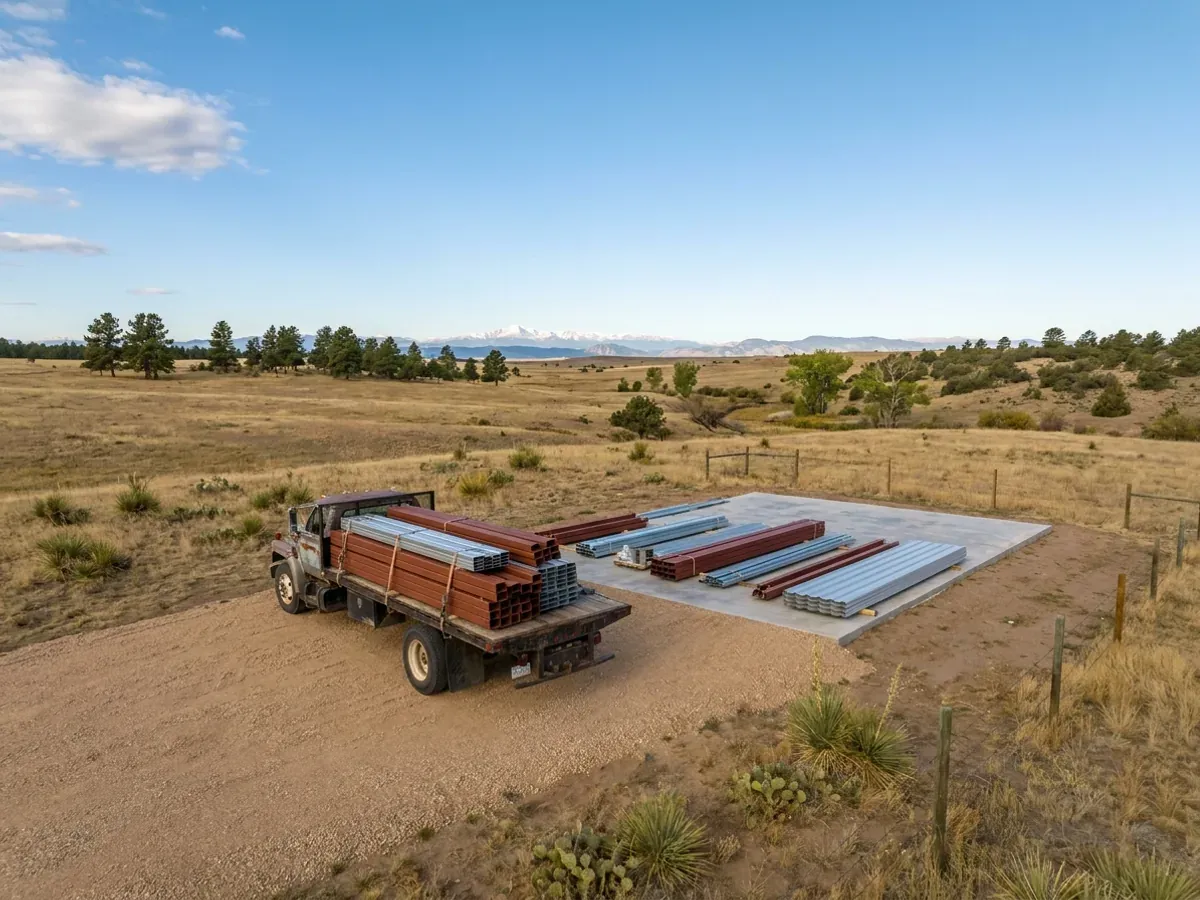
A kit is the structural shell: the frame, roof and wall panels, fasteners, trim and drawings, delivered to your land and erected there on a foundation poured there. Everything inside is built on site. Colorado's statutory definition of a manufactured home covers units whose electrical, mechanical or plumbing services are made away from the site, so a shell kit without those services falls outside it. See barndominium kits.
Modular home
Colorado law defines a modular home as a factory-built residential structure: a home built to the codes adopted by the state housing board and designed to be installed on a permanent foundation. A modular barndominium is a modular home styled like a barndominium, with metal siding, a simple gable roof and a porch, and it is regulated as a modular home.
Manufactured home
Built in a factory to the federal manufactured home construction and safety standards, on a permanent chassis, with its wiring, heating and plumbing installed before it ships. Fannie Mae looks for the HUD Data Plate and the HUD certification label on each section as evidence of that standard.
Tiny home
Under Colorado law a tiny home is built permanently on a vehicle chassis for long-term living, has services installed off site, and is no more than 400 square feet. The Division of Housing approves tiny home plans before they are built, and their sellers register with it too.
Who approves and inspects each one
Colorado has no statewide residential building code for site-built homes, but it runs a statewide program for factory-built ones. That is the core difference.
Kit: your local building department
Counties are authorized to adopt a building code for unincorporated land, in all or part of the county, and cities and towns regulate construction inside their own limits. Where a code applies, the building department reviews the plans and inspects the work. Some rural counties have no building code; where that is so, state inspectors still handle electrical and plumbing inspections. See barndominium laws in Colorado.
Modular: the state insignia
Factory-built structures sold or offered for sale in Colorado must bear an insignia of approval issued by the Division of Housing. The division reviews the design and inspects the construction done in the factory, and the statute tells local governments not to duplicate that review or charge permit fees to cover it.
Modular: the lot is still local
A 2025 law, SB25-002, spells out that site work unrelated to installing the factory-built structure, such as a foundation system and any site-built component connected to it like a garage or deck, is subject to local government rules. A modular home still needs whatever local permits your jurisdiction requires for the work on the lot.
Manufactured: authorization, inspection, insignia
Before a manufactured or tiny home is installed, the owner or a registered installer must get an installation authorization from the Division of Housing, or follow the local government's process where it inspects on the division's behalf. A passed inspection earns an installation insignia. Where there is no building department, the Division of Housing says it reviews and inspects the foundation design for manufactured homes itself.
New rules from July 2026
SB25-002 directed the state housing board to adopt regional building code standards for factory-built structures that account for local climate, geography and fire protection. The Division of Housing says its rules as adopted took effect July 1, 2026, and that it is updating forms to implement the law. Ask both the seller and your local building department which standards apply to your parcel.
Foundations, snow and the roof
The snow a roof has to carry is set by the jurisdiction, not by the state. How that number reaches your building depends on which of the three you buy.
Kit: drawn to your jurisdiction's numbers
A kit's frame and foundation are drawn to the snow load, wind speed and frost depth that your city, town or county sets for your parcel. There is no single statewide figure. Many Colorado engineers work from the Structural Engineers Association of Colorado's snow-load maps.
Modular: local conditions count
State law leaves room for local governments to set standards for modular homes on roof snow loads, wind and wildfire risk, and SB25-002 folds those conditions into regional code standards. The home's approved design has to fit where it will stand, so give the seller your exact parcel before you compare quotes.
Manufactured: HUD's roof load zone
HUD's construction standard places the whole of Colorado in its Middle Roof Load Zone. Unless HUD has granted an exemption, Colorado statute bars a local government from imposing different roof snow load or wind requirements on the design of a HUD-code home, though it may require on-site mitigation. Ask your building department what it requires on site before you choose a home.
What goes under it
A kit sits on a foundation designed and poured for it: a slab, a stem wall or a basement. A modular home sits on a permanent foundation governed by local rules. A manufactured home is installed to the manufacturer's instructions, and for the loans it buys, Fannie Mae requires a permanent foundation system suited to the site's soil that meets local and state codes.
Financing, appraisal and title
Lenders draw their line between modular and manufactured, not between factory-built and site-built.
Modular is treated like site-built
Fannie Mae's Selling Guide says modular, prefabricated, panelized and sectional housing is not manufactured housing and gets the same treatment as site-built housing. It must be built of the same quality materials as site-built housing, be legally classified as real property, and conform to local building codes where it stands.
Manufactured homes have extra conditions
For a manufactured home, Fannie Mae requires a HUD-code home on a permanent chassis, attached to a permanent foundation system and legally classified as real property, at least 12 feet wide with at least 400 square feet of finished area above grade, and with the towing hitch, wheels and axles removed.
Most new manufactured homes are personal property
The Census Bureau reports that 78% of new manufactured homes placed in the United States in 2024 were titled as personal property and 18% as real estate. Title decides which loans are open to you, so ask a lender how it treats the home and land you are considering before you commit.
A kit is financed as new construction
A site-built barndominium is financed like any custom home, typically with a construction-to-permanent loan, and the appraisal is the step to plan for. See how to finance a barndominium in Colorado.
What the published prices cover
We publish no prices of our own. This is what third-party data says for Colorado, and what it leaves out.
New manufactured homes in Colorado
The Census Bureau's Manufactured Housing Survey puts the 2025 average sales price of a new manufactured home in Colorado at $127,100, with $90,900 for a single-section home and $166,900 for a double-section home. Dealers are told to include their set-up costs, and the Census Bureau notes some costs of preparing a home for occupancy may not be included.
A home price is not a homesite price
Land, the foundation, a well, a septic system, utility connections, the driveway and permits are separate. In Colorado the septic permit comes from the local public health agency and the well permit from the Division of Water Resources, each with its own timeline.
Modular and kit prices
The Census price series covers HUD-code homes only. For a modular home, ask for a delivered-and-set price that names the foundation, the crane and the site work. For a site-built barndominium, the barndominium cost guide sets out cited third-party cost data.
Reading this because you are weighing a build? The next step is a plan drawn for your program.
What's different about Colorado
Sellers of manufactured and tiny homes must register
Colorado law requires anyone in the business of selling manufactured homes or tiny homes to be installed in Colorado to register with the Division of Housing first. Ask a seller for that registration before you pay a deposit.
Factory builders answer to the state
Under C.R.S. 24-32-3311, manufacturers of factory-built structures to be installed in Colorado register with the Division of Housing, follow its escrow rules for down payments, and provide a letter of credit, certificate of deposit or surety bond. None of that applies to a kit supplier, because a shell kit is not a factory-built structure.
The agricultural exemption is not a shortcut
A county building code may exempt buildings used solely to shelter farm implements, farm products or livestock. A barndominium someone lives in is a dwelling, whether it was built from a kit or in a factory.
Utility connections are licensed trades
SB25-002 requires plumbing or electrical work that connects a factory-built structure to outside utilities, beyond what the installer is authorized to do, to be done by a licensed plumber or electrician under a registered contractor. On a site-built barndominium, licensed electricians and plumbers handle those trades as well.
Can you get a modular barndominium in Colorado?
Is a barndominium kit a prefab home?
Does a modular home need a local permit in Colorado?
How much do modular homes cost in Colorado?
Is a modular home easier to finance than a barndominium?
Can a manufactured home handle Colorado snow?
Do you sell or install modular or manufactured homes?
Questions answered? Tell us what you want to build and we will put real numbers against it.
Sources
- Colorado Revised Statutes 2024, Title 24, Part 33 (24-32-3302 definitions; -3311 factory-built certification; -3317 installation; -3318 local standards; -3323 seller registration) (PDF) — 2024 edition; amended in 2025 by SB25-002 (see below)
- Colorado General Assembly — SB25-002, Regional Building Codes for Factory-Built Structures (signed 8 May 2025) — Foundation systems and site-built components such as a garage or deck subject to local government rules; regional code standards; licensed trades for utility connections
- Colorado Division of Housing — Factory Built Structures — Plan review and certification of factory-built structures; installation inspection; foundation review where there is no building department; rules effective July 1, 2026
- Colorado Revised Statutes 2024, Title 30 (30-28-201 and -205, county building codes and the agricultural exemption) (PDF)
- 24 CFR 3280.305, Structural design requirements (HUD manufactured home standard; roof load zones)
- Fannie Mae Selling Guide B2-3-02, Special Property Eligibility and Underwriting Considerations: Factory-Built Housing (02/04/2026)
- U.S. Census Bureau — Average Sales Price of New Manufactured Homes by State, 2014–2025 (Manufactured Housing Survey) — Colorado 2025: $127,100 total; $90,900 single-section; $166,900 double-section
- U.S. Census Bureau — Manufactured Housing Survey glossary (sales price includes dealer set-up costs)
- U.S. Census Bureau — Cost & Size Comparisons: New Manufactured Homes and New Single-Family Site-Built Homes — 2024: 78% titled as personal property, 18% as real estate
Keep reading
The pages that answer the next question this one raises.
Barndominium kits
Steel and pole-barn shell kits drawn to the snow load your own jurisdiction sets.
Read itTurnkey builds
One team from land and permits to a finished site-built barndominium.
Read itBarndominium cost guide
Cited third-party cost data for a site-built barndominium in Colorado.
Read itHow to finance a barndominium
Construction-to-permanent loans and why the appraisal is the hard part.
Read itBarndominium laws in Colorado
Who issues the building, septic and well permits for your parcel.
Read itTell us about your land
Start the survey for a site-built barndominium on your parcel.
Read itWant a real number instead of a range?
Start the survey and tell us about your land and what you want to build. Include the county and parcel ID if you have them, because in Colorado the jurisdiction, the soil, the water and the septic answers change the budget more than the building does. The survey costs nothing.