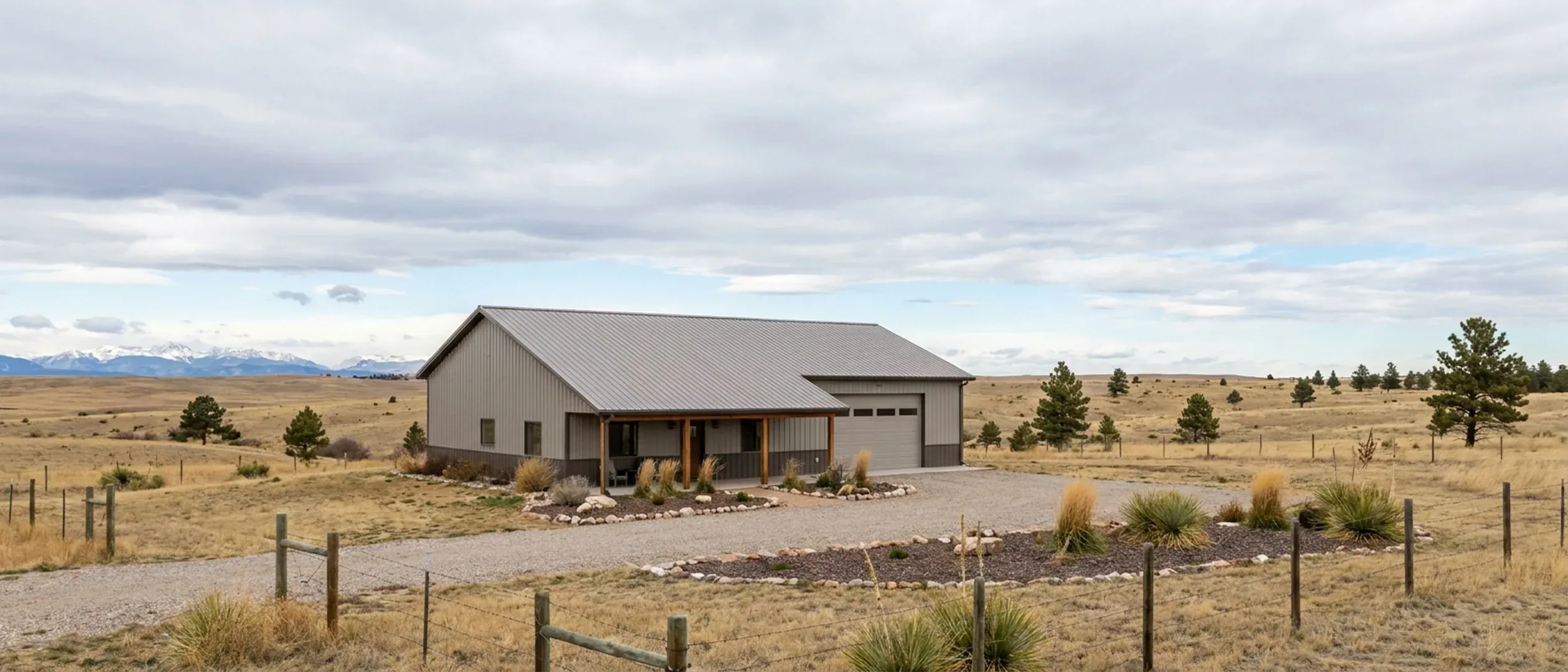
Barndominium Cost & Price in Colorado: Per Square Foot
Nobody publishes a measured cost per square foot for barndominiums in Colorado. What does exist is close enough to plan with. The Census Bureau measures the contract price of custom homes built on the owner's own land, which is how nearly every barndominium gets built, and it reports the West region, which includes Colorado. The USDA publishes what Colorado farm, crop and pasture land is worth per acre. Colorado's ground adds its own lines: swelling clay soils that change the foundation, septic permits priced by each county's health department, and a water question to answer before you buy. This guide puts those numbers side by side, each with its source, and shows which parts of the total a steel or post-frame shell changes and which it does not. None of it is our pricing.
Figures below are industry data from cited third-party sources, not a quote from Colorado Barndominium Builders. Every project is priced individually.
Bottom Line Up Front
- The closest published benchmark is the Census Bureau's 2025 figure for contractor-built homes on the owner's land in the West: a median contract price of $177 per square foot and an average of $214, land excluded. The Census median contract price for the whole house in the West was $377,200.
- A barndominium shell changes the framing and exterior line of the budget. NAHB's 2024 survey puts framing at 16.6% and exterior finishes at 13.4% of construction cost, while interior finishes (24.1%) and mechanical rough-ins (19.2%) cost the same whatever holds the roof up.
- Colorado land and ground are separate lines: USDA NASS puts Colorado farm real estate at $2,360 an acre in 2026, the Colorado Geological Survey calls swelling soil the state's most significant geologic hazard, and a new septic permit alone is $1,120 in Arapahoe County and $1,235 in La Plata County.
Published cost figures
Third-party and government figures, each with its source. None of them is a quote, and none of them is ours.
| Measure | Range | Source |
|---|---|---|
| Contractor-built homes on the owner's land, West region, 2025 — median to average contract price (land excluded) | $177–$214 per sq ft | U.S. Census Bureau, Survey of Construction, Characteristics of New Housing 2025: West median $176.87, average $213.85 contract price per sq ft of contractor-built houses started — https://www.census.gov/construction/chars/xls/contractpricesqft_cust.xls |
| New homes sold by builders, West region, 2025 — median to average sales price (lot excluded) | $212–$224 per sq ft | U.S. Census Bureau, Characteristics of New Housing 2025: West median $212.50, average $224.31 price per sq ft of floor area, new single-family houses sold — https://www.census.gov/construction/chars/xls/soldpricesqft_cust.xls |
| Average construction cost only (no lot, overhead or profit), national builder survey, 2024 | $162–$162 per sq ft | NAHB Cost of Constructing a Home 2024 (published 20 Jan 2025): average construction cost $428,215, about $162 per sq ft — https://www.nahb.org/news-and-economics/housing-economics-plus/special-studies/special-studies-pages/cost-of-constructing-a-home-in-2024 |
| Colorado land, 2026 — pasture to irrigated cropland average | $1,200–$7,050 per acre | USDA NASS, Land Values 2026 Summary (released 31 Jul 2026): Colorado pasture $1,200, irrigated cropland $7,050 average value per acre — https://www.nass.usda.gov/Publications/Todays_Reports/reports/land0726.pdf |
Estimate a range for your square footage
Pick a size and a tier and this multiplies them against the same industry ranges printed in the table above, nothing new, nothing ours. It's a starting orientation, not a quote.
Estimated range
$354,000 – $428,000
Source: U.S. Census Bureau, Survey of Construction, Characteristics of New Housing 2025: West median $176.87, average $213.85 contract price per sq ft of contractor-built houses started — https://www.census.gov/construction/chars/xls/contractpricesqft_cust.xls
This estimate comes from the third-party cost data cited in the table above, not from Colorado Barndominium Builders. It doesn't account for your land, your county, or your finish choices, all of which move the real number. Start the survey with your parcel for one that does.
Total cost by size
Rough totals at common sizes. These move with everything on this page, so treat them as a starting orientation, not an estimate for your project.
1,500 sq ft
$265,000–$321,000
Arithmetic: 1,500 sq ft × the Census 2025 West contract price per sq ft ($176.87 median, $213.85 average), land excluded — https://www.census.gov/construction/chars/xls/contractpricesqft_cust.xls
2,000 sq ft
$354,000–$428,000
Arithmetic: 2,000 sq ft × the Census 2025 West contract price per sq ft ($176.87 median, $213.85 average), land excluded — https://www.census.gov/construction/chars/xls/contractpricesqft_cust.xls
2,400 sq ft
$424,000–$513,000
Arithmetic: 2,400 sq ft × the Census 2025 West contract price per sq ft ($176.87 median, $213.85 average), land excluded — https://www.census.gov/construction/chars/xls/contractpricesqft_cust.xls
3,000 sq ft
$531,000–$642,000
Arithmetic: 3,000 sq ft × the Census 2025 West contract price per sq ft ($176.87 median, $213.85 average), land excluded — https://www.census.gov/construction/chars/xls/contractpricesqft_cust.xls
What actually moves the number
Finish level, not the shell
In NAHB's 2024 cost survey, interior finishes were 24.1% of construction cost and plumbing, electrical and HVAC rough-ins another 19.2%. Those are the same trades and fixtures in a barndominium as in any house, so the finish schedule you choose moves the total more than the frame does.
Swelling soils and the foundation
The Colorado Geological Survey calls expansive, swelling soil Colorado's most significant geologic hazard, and says volume increases of 3% or more are generally treated by engineers as needing specially designed foundations. Where a soils report finds those clays, drilled piers, grade beams and structural floors replace a simple slab, and foundations were already 10.5% of construction cost in NAHB's survey.
Septic and water
Forty percent of the contractor-built homes finished in the West in 2025 had their own septic system, and 26% had both a septic system and their own well, per the Census Bureau. In Colorado the septic permit comes from the local public health agency, under the state's Regulation 43 minimums: Arapahoe County charges $1,120 for a new permit, La Plata County $1,235. Drilling and installation are priced on top.
Land, access and elevation
USDA NASS puts Colorado pasture at $1,200 an acre and irrigated cropland at $7,050 in 2026. A building site also needs a drive, a power run and grading, and at higher elevations the design snow load your county or city publishes drives the roof framing. NAHB counts site work and final steps as separate lines from the house itself.
Why the Census figure is the right one to start from
Most cost numbers you will see online are national, unsourced, or describe homes built very differently from a barndominium on rural land. The Census Bureau's contractor-built series avoids all three problems.
It measures homes built on the owner's land
The Census Bureau's Survey of Construction separates homes a builder puts up for sale from homes a contractor builds for an owner on the owner's own lot. That second group is a barndominium's situation almost exactly, and its contract price excludes the land, so the figure compares like with like.
It reports the West, which includes Colorado
For contractor-built homes started in 2025, the Census Bureau reports a West median of $176.87 per square foot and an average of $213.85. The Census Bureau reports a West median contract price for the whole house of $377,200 and an average of $535,700. There is no Colorado-only cut of this series, so the West figure is the closest published measurement.
Why the median and the average are far apart
In the Census Bureau's West figures the average contract price per square foot sits about $37 above the median, a wider gap than the median-to-average spread for builder-sold homes. A few very expensive custom homes pull the average up. For a plain, well-planned barndominium the median is the better anchor; a high-finish mountain build will sit nearer the average or above it.
What the number leaves out
Contract price covers the building. It does not include the land, and on a rural parcel the well, septic, driveway and power run may sit in separate contracts. Add those as their own lines before comparing any quote to the Census figure.
Where a barndominium's money actually goes
NAHB's 2024 Cost of Constructing a Home survey breaks construction cost into eight stages. Read it with a barndominium in mind and it shows which parts of the budget the building type can change.
The shell: framing and exterior finishes
NAHB puts framing at 16.6% of construction cost and exterior finishes (siding, roofing, windows and doors) at 13.4%. This roughly 30% is the part a steel or post-frame building system replaces, and it is where metal cladding and clear-span framing can change the number in either direction.
The inside: finishes and systems
Interior finishes (24.1%) and major system rough-ins (19.2%) are over 43% of construction cost in NAHB's survey. Drywall, cabinets, flooring, plumbing, wiring and HVAC cost the same in a barndominium as in a conventional house of the same size and finish, and licensed plumbers and electricians handle those trades.
The ground: foundation and site work
Foundations run 10.5% and site work 7.6% in NAHB's national figures, which include averages of $7,640 in building permit fees, $6,367 in impact fees and $6,260 in water and sewer fees and inspections. On Colorado's swelling clays the foundation share can rise, and where a city or district charges tap fees they sit in this line.
The finish line: drive, landscaping, cleanup
NAHB's final-steps stage is 6.5% of construction cost, and its survey lists an average driveway at $9,635. A long gravel lane to a building site set back from a county road is a real cost on rural Colorado land and belongs in the budget from the start.
Land: what the USDA's Colorado figures tell you
USDA's National Agricultural Statistics Service estimates Colorado land values every year from a survey of agricultural operators. It measures farmland, not house lots, so use it as a reference point rather than a price for a building site.
Farm real estate, all land and buildings
NASS's 2026 summary puts Colorado farm real estate at an average of $2,360 an acre, up 3.1% from $2,290 in 2025. That figure includes the buildings on farms, which is why it sits above the bare pasture value.
Water is the difference in cropland
NASS values Colorado irrigated cropland at $7,050 an acre in 2026 against $2,040 for non-irrigated cropland. The gap is the value of water, and it is the clearest published sign of how much a parcel's water situation changes its price in Colorado.
Pasture and dryland
Colorado pasture averages $1,200 an acre in the 2026 NASS summary, up 4.3% from a year earlier. Much of the open land sold for rural homes on the plains is pasture or dryland, but a few acres with road access, power at the line and a buildable soil price well above these averages.
Why a small parcel prices differently
The NASS survey values agricultural land by the acre. A building site near a paved road, with power available and a septic-suitable soil, is a different market that the survey does not price. Use the state figure to understand the land around you, and use recent parcel sales from the county assessor for the site itself.
The Colorado ground costs to price before you buy
In town, sewer and water come to the lot line and the soils were studied when the subdivision was platted. On rural land those are part of your build, and in Colorado each one can move the budget by more than the choice of shell.
The soils report comes first
The Colorado Geological Survey says swelling clays can expand 10% or more when wet and exert 20,000 pounds per square foot or more on foundations and slabs. A geotechnical investigation tells the foundation designer whether a slab will do or piers and a structural floor are needed, which is the single largest swing in a Front Range foundation budget.
Septic is a county permit with a real fee
Arapahoe County Public Health lists $1,120 for a new on-site wastewater permit plus a $23 state fee. La Plata County Public Health's 2026 schedule lists $1,235 for a new-construction permit application, including design review and up to two inspections. The system itself, sized and designed for your soils, is priced separately by the installer and designer.
Water: confirm it before the contract
The USDA gap between irrigated and non-irrigated land shows how much water is worth in Colorado. The Colorado Division of Water Resources issues well permits, and under C.R.S. 37-92-602 a new household well on a parcel under 35 acres may be limited to use inside the house only, with no lawn, garden or livestock water, unless an augmentation plan applies. Some parcels cannot get a well permit at all, so settle water before you buy. Arapahoe County Public Health notes that local zoning commonly looks for about 2.5 acres where a lot is served by a well.
Most custom homes in the West are on public sewer; rural ones are not
The Census Bureau reports that 60% of contractor-built homes finished in the West in 2025 were on a public sewer, 40% had their own septic system and 26% had both septic and their own well. A barndominium on acreage usually falls in the minority, so plan on both unless the parcel is served by a water district.
Reading this because you are weighing a build? The next step is a plan drawn for your program.
What's different about Colorado
Who sets your building code depends on where the land is
Colorado has no statewide residential building code. Counties may adopt a code for unincorporated land and cities and towns adopt their own, so the permit may come from a city, a county, a regional building department, or in some rural counties nobody at all. Design figures such as ground snow load and frost depth come from that same local office, which is why the budget cannot be finished until the parcel is known.
The energy code follows the local code
Under HB22-1362, a Colorado city or county that updates its building code must adopt at least the 2021 International Energy Conservation Code with electric-ready and solar-ready provisions, and updates from 1 July 2026 must adopt a low energy and carbon code. Small rural counties that are denied state grant funding may stay on one of the last three IECC editions. A jurisdiction with no building code has no energy code to enforce. Where it applies, insulation, air sealing and the mechanical design are priced to that edition.
Soils belong in the budget before the plan
The Colorado Geological Survey says bentonite and montmorillonite clays underlie many populated areas of Colorado and can swell when wet with enough force to break a structure. Its guide for homebuyers lists improper pier depth, too little reinforcing steel and poor drainage among the causes of damage. A geotechnical report is how the foundation line gets priced honestly.
Septic permits are county-priced and can need an engineer
Arapahoe County Public Health requires a professional engineer to design the septic system where limiting soils, groundwater or bedrock sit within 4 feet of the treatment area or the slope exceeds 20%. La Plata, Pueblo and Arapahoe counties all adopted updated local septic regulations in 2026 to match Colorado's revised Regulation 43, so check your county's current rules and fee schedule before you price the system.
What is the average cost to build a barndominium in Colorado?
How much would a 2,000 sq ft barndominium cost in Colorado?
Is a barndominium cheaper to build than a house in Colorado?
What does land cost in Colorado for a barndominium?
Why do foundations cost more in parts of Colorado?
Do I need a building permit for a barndominium in Colorado?
Why do barndominium cost figures online vary so much?
How do I get a real number for my land?
Questions answered? Tell us what you want to build and we will put real numbers against it.
Sources
- U.S. Census Bureau — Median and Average Contract Price per Square Foot of New Contractor-Built Single-Family Houses Started (Characteristics of New Housing 2025) — West 2025: median $176.87, average $213.85 per sq ft; contract price excludes the lot
- U.S. Census Bureau — Median and Average Contract Price of New Contractor-Built Single-Family Houses Started — West 2025: median $377,200, average $535,700
- U.S. Census Bureau — Price per Square Foot of Floor Area, New Single-Family Houses Sold — West 2025: median $212.50, average $224.31
- U.S. Census Bureau — Type of Sewage System by Water Supply Source in New Single-Family Houses Completed — West contractor-built 2025: 60% public sewer, 40% individual septic, 26% septic and individual well
- U.S. Census Bureau — Characteristics of New Housing, current tables (2025 data published 1 Jul 2026)
- NAHB — Cost of Constructing a Home 2024 — Construction cost $428,215 (about $162 per sq ft), stage shares, permit, impact, water and sewer fee and driveway averages
- USDA NASS — Land Values 2026 Summary (PDF) — Colorado 2026: farm real estate $2,360, cropland $2,960, irrigated $7,050, non-irrigated $2,040, pasture $1,200 per acre
- Colorado Geological Survey — Expansive Soil and Rock
- Colorado Geological Survey — SP-43, A Guide to Swelling Soils for Colorado Homebuyers and Homeowners
- Arapahoe County Public Health — Environmental Health fees — On-site wastewater new permit $1,120 plus $23
- Arapahoe County Public Health — Septic Systems — Engineer-designed systems where limiting layers are within 4 ft or slope exceeds 20%; 2.5 acres commonly recommended for well lots
- La Plata County Public Health — 2026 OWTS Fee Schedule (PDF) — New construction permit application $1,235; $23 CDPHE fee per C.R.S. 25-10-107
- La Plata County Public Health — Septic Systems
- Pueblo County — Onsite Wastewater Treatment System
Keep reading
The pages that answer the next question this one raises.
Barndominium vs. house cost in Colorado
The same NAHB cost stages, compared line by line for a steel or post-frame shell and a stick-built house.
Read itHow big a barndominium your budget builds
Working backward from a budget to square feet, with the land and ground costs set aside first.
Read itFinancing a barndominium in Colorado
Construction-to-permanent loans, FHA, VA and USDA options, and why appraisals are the hard part.
Read itSite preparation
Grading, pads, driveways and utility runs on rural Colorado land.
Read it40x60 barndominium floor plans
The most-asked-about footprint, with the square footage to run through the numbers above.
Read itWant a real number instead of a range?
Start the survey and tell us about your land and what you want to build. Include the county and parcel ID if you have them, because in Colorado the jurisdiction, the soil, the water and the septic answers change the budget more than the building does. The survey costs nothing.