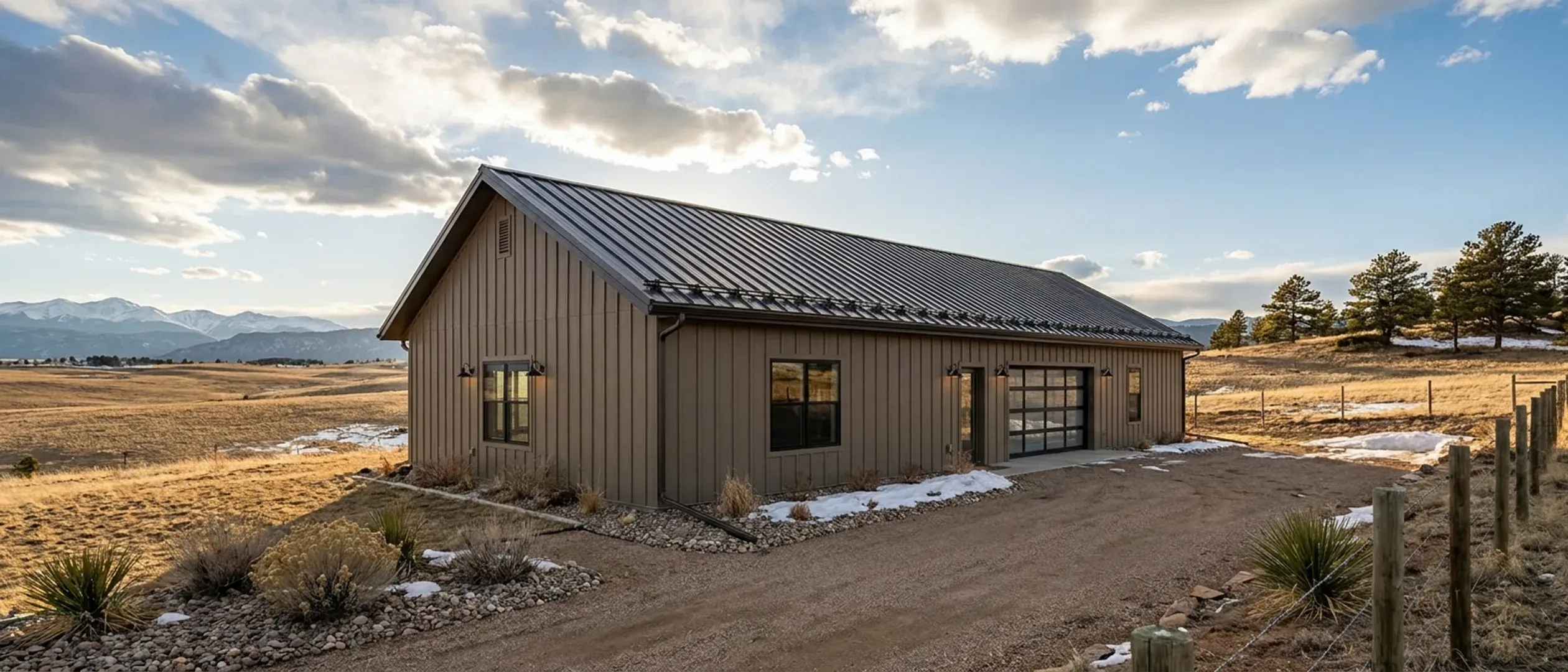
Are Barndominiums Worth It in Colorado? Land, Water & Resale
Whether a barndominium is worth it is not a question about the building type in general. It is a question about your land, your use of the shop, how long you intend to stay, and how the house will look to a lender and a buyer later. In Colorado each of those has a specific shape. The water a parcel can legally use depends on its size under the state's well statute. Swelling soils and, in mapped areas, the state's wildfire code shape what the building costs to do properly. Appraisals depend on comparable sales that rural Colorado often lacks. And the disclosures that go with a sale — the water source and well permit, among others — decide how easy the house is to sell. This page sets out where the answer is clearly yes, where it is clearly no, and what to check in between. It does not quote a cost per square foot; the cost guide does that with sourced figures.
Figures on this page are cited third-party or government data, not a quote from Colorado Barndominium Builders.
Bottom Line Up Front
- Worth it when you genuinely need shop, equipment, animal or storage space you would otherwise build separately, and you intend to stay long enough that resale variability stops mattering.
- Questionable on a short horizon, when you need the highest possible loan amount, or on a lot whose covenants, zoning or water rights will not support the shop and the use you have in mind.
- In Colorado the land often decides the project. Parcel size sets what a household well may be used for under C.R.S. 37-92-602, the soils set the foundation, and the wildfire map can set the roof and siding — check all three before you buy.
Where the answer is clearly yes
A barndominium tends to pay its way when the shop is a real need, not a bonus.
You need a real shop, and would build one anyway
If the alternative is a house plus a separate insulated shop or barn, one building with one foundation, roof and envelope is usually the better use of money.
You own or are buying acreage and intend to stay
The resale discount for a specialised house matters less the longer you live in it, and acreage is where the shop-plus-house combination makes sense.
The land's water supports your use
A parcel that can get the well permit your livestock or garden plans need removes the biggest hidden limit on a rural build.
You will pay for the foundation and the envelope
An engineered foundation for the soils, and insulation, vapor control and air sealing designed for a cold climate, are what make a metal building a comfortable, durable home.
Where the answer is probably no
None of these rules a barndominium out, but each weakens the case.
You expect to sell within a few years
A narrower buyer pool and uncertain appraisals make a short hold risky.
You need the largest possible loan
Few comparable sales can cap the appraised value, and with it the loan.
The lot is in a covenant-controlled subdivision or a city
Covenants and city zoning often restrict metal exteriors, building size or accessory uses, and dense suburbs leave little room for the shop that justifies the design.
The plan depends on skipping rules
Building in a county without a building code saves plan review, not the septic permit, the well permit, state electrical and plumbing inspection, or the wildfire code where a local government has adopted it — and the missing records follow the house to resale.
Questions that decide it for your land
Answer these before paying for plans.
Does the zoning allow a dwelling, and a building this size?
Ask the county or city planning office about the district, setbacks, height and any limit on accessory or agricultural buildings.
What well permit can the parcel get?
Check the parcel size against C.R.S. 37-92-602 and ask the Division of Water Resources, especially where you plan livestock or irrigation.
Will the soil take a septic system and a simple foundation?
A site evaluation for the local public health agency and a soils report answer both.
Is the parcel in a mapped wildfire area?
If so, the roof assembly, gutters, vents and, in higher fire-intensity areas, siding, eaves and decks carry added requirements. The Colorado Wildfire Resiliency Code lets owners request a ground-truthing review of their parcel's classification.
What will the insurer and the lender say?
Ask both before you commit to a design, including how the insurer treats metal roofing, hail and wildfire exposure at the address.
What a barndominium does not change
Some costs and rules are the same whatever the frame.
Site work, septic and well
Excavation, the driveway, the septic system and the well cost the same under a barndominium as under any house.
Interior finishes and mechanicals
Kitchens, bathrooms, flooring, heating and wiring cost about what they do in a conventional house of the same size and finish. Licensed plumbers and electricians handle those trades.
The codes that apply to the address
Where a local government has adopted a building code, an energy code and the wildfire code, a barndominium meets them like any other home.
Reading this because you are weighing a build? The next step is a plan drawn for your program.
What's different about Colorado
Water is part of the land's value
C.R.S. 37-92-602 presumes that a household well on a smaller residential lot is acceptable when used solely for household purposes inside one single-family dwelling, while a tract of thirty-five acres or more can qualify for household use plus livestock watering and irrigation of up to one acre of garden and lawn. If the reason for a barndominium is horses, livestock or a large garden, a smaller lot may not support it, however good the building. Well permits are issued by the State Engineer through the Division of Water Resources.
Why so many rural parcels are thirty-five acres
C.R.S. 30-28-101(10)(b) excludes from the definition of subdivision any division of land into parcels of thirty-five acres or more that are not intended for use by multiple owners. That is why the rural land market has so many thirty-five acre tracts. The exemption concerns county subdivision review; zoning, building codes where adopted, septic and well rules still apply to what you build on the parcel.
Appraisal is where the value question gets tested
A lender's appraiser values the house against recent sales of similar homes nearby. A combined house and shop on acreage can have few true comparables, and the shop may be valued as an outbuilding rather than as living space. That can limit the loan amount even when the building is sound. The financing guide covers the loan side.
The soils report protects the investment
The Colorado Geological Survey calls swelling soil a common and sometimes serious problem in Colorado that is capable of causing severe damage to houses. C.R.S. 6-6.5-101 requires builders and developers selling a new residence to give the buyer a summary of the soils analysis and site recommendations at least fourteen days before closing — but it does not apply to an individual building a home for their own residence. On a custom build on your own land, commissioning the soils work and following it is your protection.
What a buyer will ask for at resale
Under C.R.S. 38-35.7-104, residential listing and sale contracts must disclose the source of potable water, and where the source is a well the seller provides a copy of the current well permit if one is available. Permit records, final inspections, the septic permit and final inspection from the local public health agency, and the electrical final all help a buyer's lender and insurer. Where a county has no building code, those building records do not exist, which is a resale question rather than a legal one.
Covenants can overrule the plan
A building permit does not override private covenants. Elbert County, for example, states that issuing a county building permit will not legally authorize what private covenants prohibit, and that the county does not review, monitor or enforce HOA covenants. Many rural subdivisions restrict metal buildings, outbuilding size or livestock, so read the covenants before you buy.
Pros and cons, honestly
Pros
- One building replaces a house plus a separate shop or barn, sharing one foundation, roof and envelope.
- Clear spans make the layout adaptable as needs change.
- Steel exteriors fit the noncombustible option in the wildfire code, and do not rot.
- The fast shell lets interior work continue through winter.
- On acreage, the shop-plus-house combination matches how the land is used.
- The owner controls the soils investigation and envelope design on a custom build.
Cons
- Appraisals can be limited by a lack of comparable sales.
- Resale appeals to a narrower group of buyers.
- Smaller lots are generally limited to in-house well use, which can rule out livestock or irrigation.
- Covenants in many rural subdivisions restrict metal buildings, outbuildings or animals.
- Swelling soils can require an engineered foundation that erodes the shell's cost advantage.
- Wildfire-area requirements add to the roof, vents, eaves and decks where the map applies.
- Building where no code applies leaves no inspection records for a future buyer.
Are barndominiums worth it in Colorado?
Do barndominiums hold their value in Colorado?
Does the 35-acre rule matter for a barndominium?
Will a bank lend on a barndominium in Colorado?
Is a barndominium cheaper than a regular house?
Can I save money by building where there is no building code?
Can an HOA stop me building a barndominium?
Who should not build a barndominium?
Questions answered? Tell us what you want to build and we will put real numbers against it.
Sources
- C.R.S. 37-92-602 — exempt wells and the thirty-five acre presumption
- C.R.S. 30-28-101 — definitions, including the thirty-five acre subdivision exemption
- Colorado Division of Water Resources — Well Permitting
- C.R.S. 6-6.5-101 — soils report disclosure to purchasers of new residences
- Colorado Geological Survey — SP-43, A Guide to Swelling Soils for Colorado Homebuyers and Homeowners
- C.R.S. 38-35.7-104 — disclosure of potable water source
- Elbert County — HOA Compliance and County Liability Statement
- Colorado Division of Fire Prevention and Control — Colorado Wildfire Resiliency Code
- CDPHE — On-site wastewater treatment systems
Keep reading
The pages that answer the next question this one raises.
Barndominium pros and cons in Colorado
Wildfire, soils, snow loads, water and resale — the detail behind this page.
Read itBarndominium cost
Sourced cost figures and what drives them.
Read itBarndominium financing
Loan types, appraisals and what lenders ask for.
Read itAre barndominiums legal in Colorado?
Building codes, the wildfire code, septic, wells, zoning and covenants.
Read itShouses
The shop-plus-house design this page weighs.
Read itTell us about your land
Start the survey and we will look at whether your parcel suits a barndominium.
Read itWant a real number instead of a range?
Start the survey and tell us about your land and what you want to build. Include the county and parcel ID if you have them, because in Colorado the jurisdiction, the soil, the water and the septic answers change the budget more than the building does. The survey costs nothing.